
Benchmarking / BEPS / DC / Latest / Policies
Significant Changes in the New DC BEPS Guidebook
DOEE's BEPS Guidebook v1.2 adds real exemptions, a settlement route, and a DC BEPS Score that may not match your ENERGY STAR score. Here is what changed.
DOEE published version 1.2 of the BEPS Compliance and Enforcement Guidebook in August 2026. The edition replaces version 1.1, which was issued in February 2023. This article highlights the major substantive changes between the two documents.
So why did DOEE make major changes to the program so close to the end of Compliance Cycle 1? DOEE did not wake up and decide to rewrite the rules. Rather, the DC Council changed the law. The Building Energy Performance Standards Amendment Act of 2024, D.C. Law 25-307, took effect March 21, 2025. It extended Cycle 1 from five years to six, created new exemptions, moved the reporting deadline, and renamed the alternative compliance penalty. Version 1.2 is DOEE catching the Guidebook up to a statute that has been in force for seventeen months.
We contrast both editions against each other, line by line. Here is what actually moved and what it means if you own or manage a covered building in the District.
Why the timing works better than it looks
Cycle 1 runs January 1, 2021 through December 31, 2026, and CY2026 is the evaluation year. Performance Pathway buildings must show a greater than 20% drop in Site EUI in CY2026 against their CY2018-2019 average. Final submissions are due May 3, 2027.
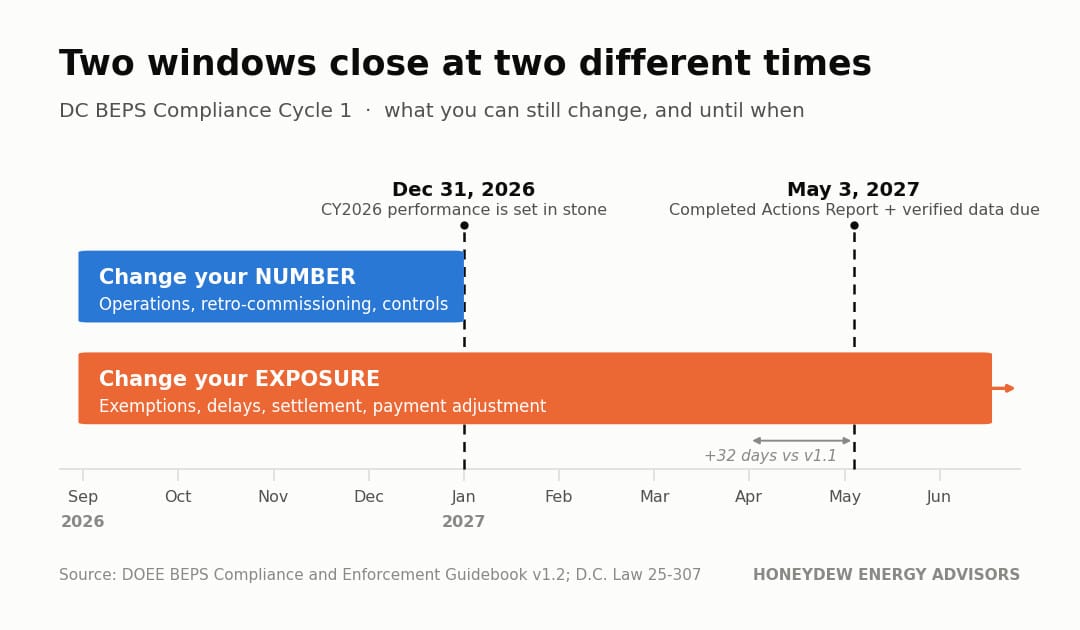
So the definitive compliance guidance landed with four months left in the evaluation year. This is obviously not ideal, but two windows close at two different times, and that distinction is worth more than the complaint. The window to change your building’s key performance metrics shuts December 31, 2026. After that your CY2026 performance is set in stone. The window to change your exposure stays open well into 2027, and almost everything new in v1.2 lives in that second window.
Change 1: The exemption grounds are not new, but the remedy is
Version 1.1 was blunt. Section 2.8, one sentence: “There is one exemption from compliance with BEPS requirements.” Demolition. That was the entire list.
Version 1.2 recognizes three grounds and gives them a chapter: demolition before or during the Cycle, financial distress, and low occupancy in CY2019 or CY2020.
Careful readers will recognize that these three grounds were already discussed at length in v1.1. However, these factors were only used for a delay of compliance. If you flip to page 63 of the old edition and see a table full of eligibility circumstances, you are looking at the delay chapter, not an exemption list. Plenty of smart people have made that exact mistake.
What changed is not the circumstances. It is what they buy you, and that is worth real money:
- A delay buys time. Up to three years. You still have to comply.
- An exemption removes the requirement. An exempt building “is not required to meet the building energy performance requirements for the current Compliance Cycle” at all. DOEE pulls it from evaluation and picks it up next Cycle.
Financial distress got promoted from the first category to both. In 2023 a distressed owner could ask for more time and nothing else. Today that same owner can ask to be removed from Cycle 1 entirely. The delays all still exist alongside it.
Low occupancy is a near twin rather than a promotion. The v1.1 delay ground covers occupancy falling below threshold during the Cycle, and that ground survives intact. The new exemption is a different test on a different window: occupancy below the Appendix B threshold in CY2019 or CY2020, the two years before the Cycle started.
Three caveats any honest advisor gives you up front:
- It is not automatic. DOEE says plainly it “will not automatically approve requests for exemptions” and can push you toward a delay instead.
- Partial demolition usually fails. A renovation qualifies only if it renders the entire structure incapable of use or occupancy. Shrink the building below the size threshold mid-Cycle and you are still covered. The Guidebook evaluates the building as it stood on January 1, 2021 and closes that door in writing.
- You have to show your work. Distress and occupancy applicants must document the compliance efforts they already made during the Cycle: a completed audit, improved O&M, low- and no-cost measures. An owner who tried and fell short is in a very different conversation than one who did nothing for six years and then asked to be excused.
One item nobody is screening for: the low-occupancy thresholds live in Appendix B, and multifamily sits at 80% of floor area occupied and operational. CY2019 and CY2020 were the COVID years. If your building averaged under 80% in either one, you may be holding a live exemption you have never looked at.
Change 2: A settlement mechanism that did not exist
The word “settlement” appears zero times in version 1.1. In version 1.2 it appears 21 times across four pages.
Section 7.4 lets DOEE enter a Building Improvement Agreement: you redirect your assessed alternative compliance payment into efficiency work in your own building instead of writing the District a check. DOEE’s reasoning is refreshingly plain. The payments incentivize compliance, “however, the payments alone do not directly serve the program goals of building-level energy efficiency improvements.”
Table 23. The exchange rate for a Building Improvement Agreement, measured against your assessed alternative compliance payment.
Qualifying project value | What you owe |
|---|---|
120% or more of your assessed payment | You owe the District nothing |
Between 100% and 120% | You top up to 120% total |
Between 80% and 100% | You pay a flat 20% on top of the project |
Under 80% | You pay the full amount |
Source: DOEE BEPS Compliance and Enforcement Guidebook v1.2, Section 7.4, Table 23.
Yes, the top rung costs more than the payment, but it is better than sending a big portion of your budget to DOEE. DOEE priced the premium deliberately to stop owners from treating a future settlement as a reason to stall today. There is also a true-up: if actual project costs land under 80% of the estimate, the shortfall converts back into a payment, with interest. This is not a program you wander into casually and wander out of cheaply.
Qualifying projects are narrow: no fuel-burning equipment, net-of-rebate costs only, and only the increment above normal end-of-life replacement counts. Budgeting the full cost of a chiller you needed anyway will not fly.
Change 3: Nine pages on proving financial distress, and condos get named
In v1.1 financial distress was a line item in a delay table with 12 mentions. Version 1.2 mentions it 71 times, makes it a general standard serving both delays and exemptions, and adds Appendix D on how to prove it. The threshold is short: distress counts only when a specific financial condition is persistent over time.
There are two tests to determine financial distress. The qualitative test is simpler because an outside institution already intervened: a notice of default on the senior mortgage uncured for 90 days, a forbearance agreement, a court-appointed receiver, a lender owning the property after default, or a deed in lieu of foreclosure. The quantitative tests apply where no such event exists, and income-producing buildings show a debt service coverage ratio under 1.15 or negative net cash flow.
Then comes the most commercially consequential paragraph in the document, which is on few people’s radar. The Guidebook states that non-income-producing buildings are “typically owner-occupied (e.g. condos, co-ops, corporate headquarters)” and gives them their own General Test: revenue below obligations, accessible cash exhausted, and an inability to raise revenues for reasons outside the owner’s control.
If you sit on a condo or co-op board, that third prong is written in your language. DOEE’s own examples of acceptable evidence include persistent delinquency rates, reserve balances materially below the minimum in your most recent reserve study, special assessments at or above 30% of the annual operating budget, documented inability to finance BEPS work despite good-faith efforts, and high concentrations of fixed-income, senior, or low-income owners.
One guardrail will sink weak applications and deserves quoting in full: “governance challenges, alone, are considered within the owner’s control.” Translation: “our board could not agree” is not financial distress. Lead with money, not meeting minutes.
Persistence means two consecutive years during the Cycle, or the final year plus the anticipated following year. That second branch is new and genuinely useful, because distress that you can see coming counts, which matters if you are staring at a 2027 loan maturity. Every submission carries an officer attestation under penalty of perjury. This is a documented financial showing, not a hardship letter.
If the disclosure itself worries you, FOIA exemptions for personal and financial information apply, and D.C. Code § 47-821(d)(2)(A) separately shields valuation records: appraisals, actual building costs, rental data, income and expense forms, and rent rolls.
Change 4: Your final deadline moved 32 days
Small, real, and worth putting in the calendar. Version 1.1 set the Completed Actions Report and the final verified benchmarking report at April 1, 2027. Version 1.2 moves both to May 3, 2027.
The path there is a nice piece of legislative trivia. D.C. Law 25-307 moved the benchmarking reporting deadline from April 1 to May 1. May 1, 2027 falls on a Saturday. So DOEE pushed to the following Monday and aligned the Completed Actions Report to the same date to keep it to one deadline. Thirty-two extra days, courtesy of the Council and the calendar.
The penalty vs payment rename
“Alternative compliance penalty” appears 27 times in version 1.1 and zero times in version 1.2. It is now referred to as the “alternative compliance payment” throughout, 45 mentions, with the calculation appendix retitled to match. This was not an editor with a find-and-replace. D.C. Law 25-307 directs the change in statute, in language as dry as it gets: “change the term ‘alternative compliance penalties’ to ‘alternative compliance payments.’” The Council made a deliberate choice, and the framing shift is the point. A penalty is punishment for breaking something. A payment is one of several ways to become compliant with regulations. Given that Section 7.4 now lets you spend that payment inside your own building, the new word describes the mechanism more accurately than the old one did.
Whether the rename carries legal weight beyond framing is a fair question and not one we are qualified to answer. It is worth an hour with your CPA and counsel, because the federal tax treatment of amounts paid to a government can turn on whether they are characterized as a fine or penalty versus a payment made to come into compliance. We are not offering tax advice here. We are saying the question is now worth asking, and it was not worth asking in February 2023.
Your ENERGY STAR Score may not be your compliance score
This one has no headline, sits in a renumbered subsection, and is the change most likely to blindside a building if it falls under one of the following space types: hospitals, medical offices, and convenience stores, plus anything that added EV charging.
Version 1.1 handled EPA’s habit of updating its scoring models with a single sentence of principle and no mechanism. Version 1.2 names a metric: the DC BEPS Score, defined as the score a building would have received under the ENERGY STAR models in effect on January 1, 2021. The term appears zero times in v1.1 and 22 times in v1.2, with its own glossary entry and a starring role in the payment adjustment formula in Appendix E.
EPA has changed or added models for six property types since the Standards were set: Hospitals (2021), Medical Office (2022), Single-Family Homes (2022), Convenience Stores with and without Gas Stations (2023), Vehicle Dealerships (2023), and EV Charging Station adjustments (2024).
Here is DOEE’s own example of why it matters: a Medical Office building complies with the Standard Target Pathway “if it achieves a DC BEPS Score of at least 62, even if its ENERGY STAR Score is less than 62.”
So how do you actually get this number?
This is the question the Guidebook answers least well, and the answer surprises people.
It is not in Portfolio Manager, and it cannot be. There is no version toggle and no archived score sitting behind your account. Your 2021-model number does not exist on your side of the wall. The answer is that DOEE holds it. The glossary is explicit: the DC BEPS Score “is calculated by DOEE using a methodology based on the U.S. EPA ENERGY STAR scoring models in Portfolio Manager that were in effect on January 1, 2021.” DOEE has the 2021 models. You do not.
And here is the gap. For the Performance Pathway, DOEE commits in writing to publish its equivalent 2021-model metric: “DOEE will publish on the Building Owner Portal the Adjusted Site EUIs it calculates using these models.” For the Standard Target Pathway, where the DC BEPS Score actually decides compliance, v1.2 contains no matching commitment anywhere. DOEE says it will use the Score. It never says it will show you the Score.
What does exist is a request path, and it is one sentence at the top of Appendix E on page 103: “Building owners may request interpretation or guidance from DOEE on how the payment adjustment might be calculated for their building.”
So the practical playbook is three steps:
- Ask DOEE in writing, in 2026. Email [email protected] and request the DC BEPS Score for your evaluation year and the basis it was calculated on. Do it now, while DOEE has bandwidth, rather than in April 2027 when every consultant in the District sends the same email in the same week.
- Bracket it with Table 36. DOEE published the Standard and the Score 20% away from the Standard for every property type on page 104. That will not give you your exact number, but it lets you model the payment adjustment across a range and tell a board what the spread looks like without waiting. Good enough for planning, not good enough for a filing.
- Reconstruct it only as a last resort. You can in theory rebuild the number from Source EUI and EPA’s 2021-era technical reference for your property type. EPA does not cleanly archive superseded models, so this is forensic work against archived documents rather than a lookup. Treat it as a cross-check on whatever DOEE returns.
Please note this only applies to four building types. The DC BEPS Score governs the Standard Target Pathway, and only four of those six property types are eligible for that pathway at all: Hospitals, Medical Office, and Convenience Stores with and without Gas Stations. Vehicle Dealerships and Single-Family Homes do not appear on the eligible list — they are only eligible for adjusted site EUI based pathways like the Performance Pathway. So the buildings to pull are your Standard Target hospitals, medical offices, and convenience stores, plus anything that added EV charging.
Of course if all of this is confusing, don’t hesitate to reach out to us for assistance with these requests.
One clarification while we are here
Not every covered building can use the Standard Target Pathway. Eligibility is limited to “high-performing” property types, meaning those whose Standard is at least as efficient as the national median, and Table 5 publishes the closed list of roughly 45 types for Cycle 1. Office, multifamily, hotel, retail, medical office, hospital, and most of what we work on are on it. Several common types are not, including K-12 schools, worship facilities, warehouses, and vehicle dealerships. Those buildings run the Performance Pathway or a prescriptive route instead.
That matters for reading one rule that did not change between editions: a mid-Cycle EPA score change will not move your property type onto or off that list. If your type was eligible on January 1, 2021, it stays eligible through Cycle 1, and if it was not, a favorable model update mid-Cycle will not let you switch in.
The deletion: Chapter 5 got de-COVIDed
COVID-19 references drop from 54 to 6. Version 1.1’s Section 5.1, the COVID-19 Public Health Emergency Delay, is gone entirely and the rest of the chapter renumbered around the hole.
Nothing replaced it because nothing needed to. Financial distress is now a general ground with a real test, which beats a pandemic-specific carve-out. But if your compliance plan still leans on a COVID-era delay theory, the current edition does not describe one.
What to do with four months left
Run two tracks at once.
Before December 31, move your number. Operational measures, retro-commissioning corrective actions, and controls work can still shift a full-year figure. A capital project that will not produce meaningful 2026 data mostly cannot, which is an argument for redirecting that energy rather than stopping.
After December 31, move your exposure. The payment adjustment for partial progress is built in. The settlement route opens once you file verified CY2026 data and stays open until an enforcement letter goes unanswered. Delay and exemption requests run on their own clocks, and we would file them before December 31 rather than bet a client’s outcome on a later date.
The same principle runs underneath every new section of this Guidebook: effort is evidence. DOEE weighs compliance history when it decides whether to settle. Chapter 6 asks exemption applicants what they already tried. The record you build in 2026 is the record someone at DOEE reads in 2027.
Honeydew Energy Advisors works with DC building owners and property managers on benchmarking, BEPS pathway strategy, and compliance documentation. Not sure where your building stands heading into the close of Cycle 1? Get in touch and we will tell you, in plain numbers.
Call us at 202-670-9625 to talk to an advisor.
Sources: District of Columbia Department of Energy and Environment, BEPS Compliance and Enforcement Guidebook for Compliance Cycle 1, versions 1.1 and 1.2 (dc.beam-portal.org); Building Energy Performance Standards Amendment Act of 2024, D.C. Law 25-307. This article is general information, not legal, tax, or accounting advice, and does not supersede DC law or regulation.