
What to Know Before You Design
If you’re building in Arlington right now, especially affordable housing, these requirements will shape your project.
Arlington’s updated sustainability standards affect:
- Your roof
- Your gutter and irrigation systems
- Your stormwater strategy
- Your early financial assumptions
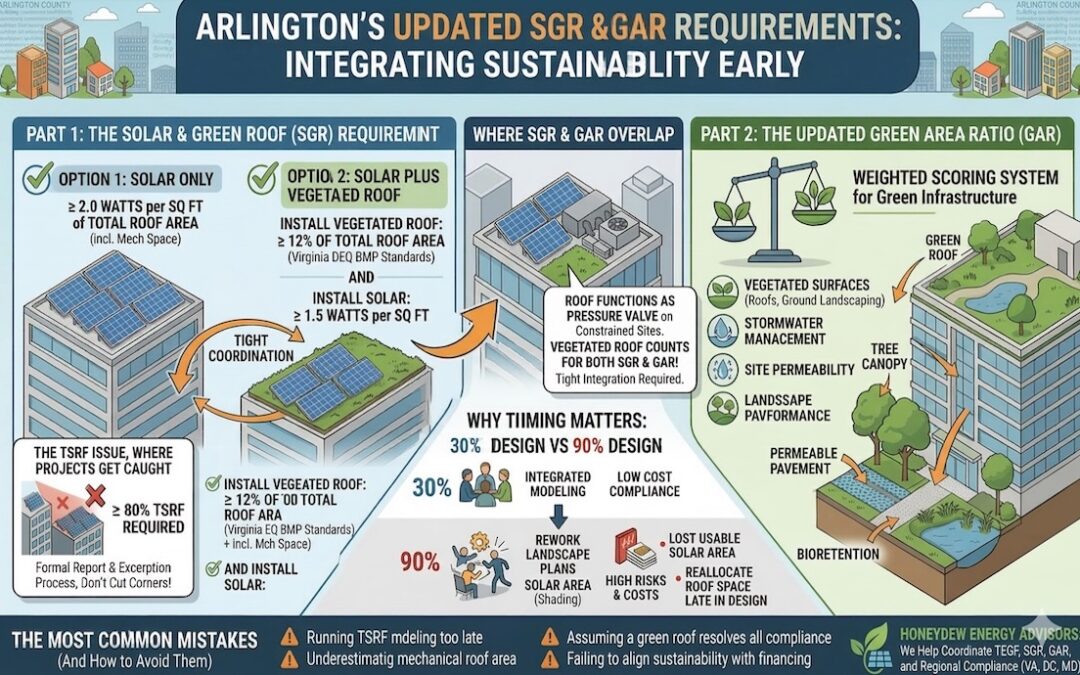
Between the Solar and Green Roof requirement, SGR, and the updated Green Area Ratio standards, GAR, sustainability needs to be part of the conversation at project kickoff, not at schematic design wrap-up. If you wait too long, redesign costs follow.
Part 1: The Solar and Green Roof Requirement
Projects must choose one of two compliance paths.
Option 1: Solar Only
Install on-site solar equal to at least 2.0 watts per square foot of total roof area, including mechanical space.
Option 2: Solar Plus Vegetated Roof
You can reduce the solar requirement if you:
- Install a vegetated roof covering at least 12 percent of total roof area
- Meet Virginia DEQ BMP standards
- Install solar at 1.5 watts per square foot
On paper, that looks like a simple trade-off. In practice, it requires tight coordination between architect, civil, structural, and solar teams. You need to start that coordination early.
The TSRF Issue, Where Projects Get Caught Off Guard
Any roof area that counts toward the solar requirement must achieve a Total Solar Resource Fraction, TSRF, of at least 80 percent.
If adjacent buildings create too much shading, you can request an exemption. That process is not a simple checkbox.
A qualified solar professional, such as Honeydew Energy Advisors, must prepare a formal report documenting insufficient TSRF. The documentation must stand up to review. Historic districts and tax credit projects may qualify for additional exemption pathways, but they still require formal documentation.
Don’t cut corners or leave this for the last minute!
Part 2: The Updated GAR Requirements
At the same time, Arlington’s GAR standards raise expectations around:
- Vegetated surfaces
- Stormwater management
- Site permeability
- Landscape performance
GAR is not a landscaping checkbox. It operates as a weighted scoring system that assigns value to green infrastructure elements such as green roofs, tree canopy, permeable pavement, and bioretention.
This is where SGR and GAR begin to overlap.
- A vegetated roof can count toward both SGR compliance and your GAR score.
- Tight sites with limited ground-level area push more performance requirements onto the roof.
- Stormwater and solar compete for the same square footage unless you coordinate them carefully.
On a constrained urban infill site, the roof becomes your pressure valve.
Why This Needs Attention at 30 Percent Design, Not 90 Percent
Teams now raise these issues during schematic design, LIHTC applications, financing reviews, and civil coordination meetings. By that point, they already affect:
- Structural loading
- Roof congestion
- Mechanical placement
- Landscape layout
- Electrical capacity
- Stormwater strategy
When teams treat solar modeling and GAR strategy as separate workstreams, problems follow. Projects reallocate roof space late in design. They lose usable solar area to unexpected shading. They miss TSRF thresholds. They rework landscape plans after civil drawings nearly reach completion.
Roof and site function as linked systems. Decisions on one side affect the other.
A Quick Example
Assume:
- A 20,000 square foot roof
- A tight urban infill site
- Significant mechanical equipment
- GAR targets that require vegetated surfaces
You might choose a green roof to support GAR scoring. That decision allows you to reduce the solar requirement from 2.0 watts per square foot to 1.5 watts per square foot under the combined SGR path.
You still must meet the 80 percent TSRF threshold. You may need to reorganize mechanical equipment to preserve solar access. None of that works easily once the structural system locks in.
Part of a Larger Regional Shift
Arlington does not operate in isolation. In Maryland, buildings over 35,000 square feet must comply with statewide benchmarking requirements under Maryland BEPS. The first reporting deadline was September 1, 2025. Going forward, the annual deadline falls on June 1. DC already mandates solar and green roof performance for new construction.
Across the region, sustainability requirements have moved from voluntary best practices to embedded permitting and financing conditions. If you develop across Virginia, DC, and Maryland, this is the direction of travel.
The Most Common Mistakes We See
- Running TSRF modeling too late
- Underestimating how much roof area mechanical equipment will occupy
- Treating GAR and SGR as separate problems
- Assuming a green roof automatically resolves compliance
- Failing to align sustainability modeling with financing documentation
You can fix all of these issues, but only if you catch them early.
How Honeydew Helps
We work with developers and affordable housing teams to coordinate:
- TSRF and solar feasibility modeling
- Solar and green roof integration
- GAR strategy alignment
- Exemption documentation
- Financing-ready technical analysis
- Regional compliance planning across Virginia, DC, and Maryland
Our goal is clarity before design decisions harden. Compliance costs far less at 30 percent design than at 90 percent.
Arlington’s new requirements do not simply add scope. They change baseline assumptions.
Your roof now functions as energy infrastructure.
Your landscape now functions as performance infrastructure.
If you’re starting a project in Arlington and want to understand how SGR and GAR will affect your site before drawings lock in, we can review it with you. Modeling early costs less than redesigning late.