
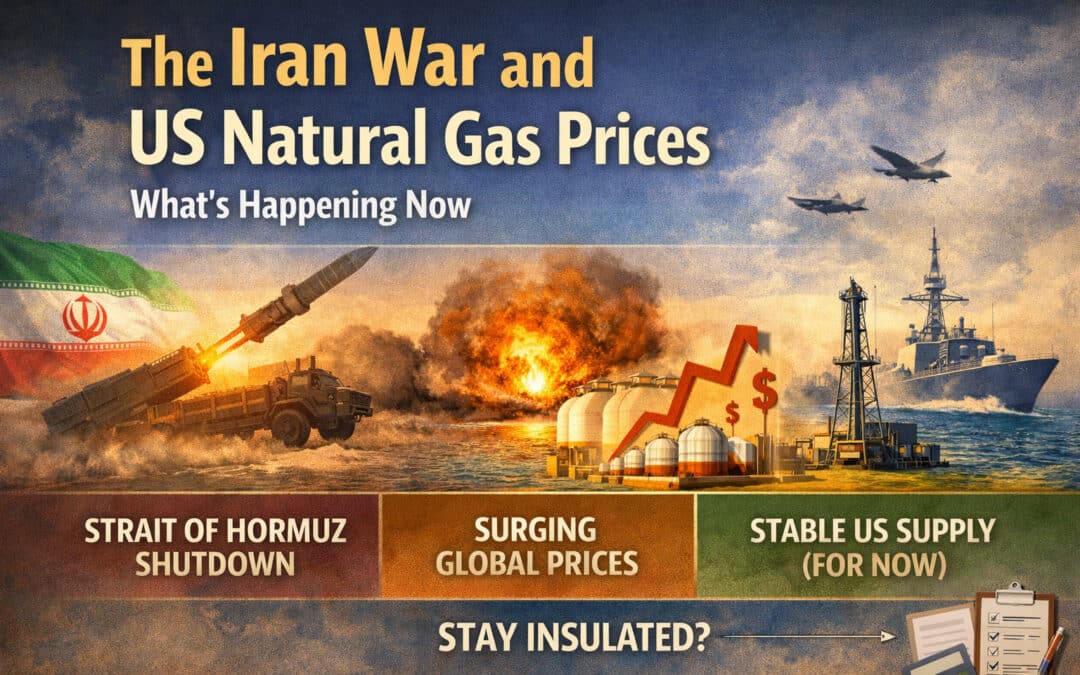
If you follow natural gas markets, you know prices never move for just one reason. Since the US and its allies launched military operations against Iran in early 2026, energy analysts, traders, and building owners have all been asking the same question: is this going to show up on my gas bill?
The short answer: not yet, at least not directly. But the conditions that could change that picture are starting to stack up. Here is where things stand and what could shift the equation in the months ahead.
Why Iran Matters to Energy Markets (Even Though the US Doesn’t Import Iranian Gas)
Iran holds the world’s second-largest proven natural gas reserves, behind only Russia, and is the third-largest producer globally. The US does not buy Iranian gas directly because sanctions have blocked that trade for decades. So why do markets care?
Two reasons. First, natural gas is increasingly a global commodity, not just a regional one. As US LNG exports have grown, American gas prices now connect more tightly to international supply and demand. When global supply tightens anywhere, it pulls on prices everywhere. Second, the Strait of Hormuz, which Iran controls the northern coastline of, carries roughly one-fifth of the world’s traded LNG. Any serious threat to that shipping lane creates immediate anxiety across global energy markets, even if no cargo has been disrupted yet.
So Far, the Disruption Has Been Contained Domestically
Despite the scale of the conflict, Henry Hub spot prices have not spiked the way oil markets did in the early weeks of the war. According to the EIA’s March 2026 Short-Term Energy Outlook, Henry Hub is expected to average around $3.80/MMBtu in 2026 – roughly 13% lower than the agency forecast just a month earlier, largely because milder February temperatures left more gas in storage than anticipated. A few factors explain why US prices have held:
US domestic production remains near record highs. American natural gas production set new records in late 2025 and held steady into 2026, giving the domestic market a cushion against external shocks. The Permian Basin, Haynesville, and Appalachian fields continue producing at full capacity, and storage levels entered the conflict period in reasonable shape.
Iran’s gas production largely serves its own domestic market. Unlike oil, which Iran exports in large volumes, most Iranian natural gas stays inside the country or flows by pipeline to neighboring Turkey and Iraq. The global LNG market does not depend directly on Iranian exports, so removing Iranian supply does not create an immediate hole in global LNG availability.
The EIA notes one specific reason US prices remain insulated: US LNG export terminals were already running at high utilization before the conflict began, which limits the ability to ramp up exports to take advantage of elevated European and Asian prices. That same constraint also limits how much the global price spike can pull on domestic supply.
But the Underlying Pressures Are Already Real
Even without a domestic price spike, the conflict has introduced real friction into global gas markets. A few things are happening right now that building owners and energy buyers should watch closely.
The Strait of Hormuz has effectively closed. Iran has closed the strait to most shipping traffic during the conflict, while claiming to allow passage for vessels from non-enemy nations. According to AP News reporting from March 24, 2026, attacks on ships have stopped nearly all tanker traffic, and Bahrain has put forward a UN Security Council resolution calling for countries to use “all necessary means” to reopen the waterway. The AP reports the closure has sent fuel prices skyrocketing and threatened the global economy. About one-fifth of global oil supply and roughly the same share of global LNG trade normally transit the strait.
Global LNG prices have surged even as US prices haven’t. According to the American Action Forum, European and Asian natural gas prices have risen as high as $19/MMBtu – more than five times current Henry Hub levels – in response to the disruption. Qatar, the world’s largest LNG exporter, has announced a complete halt of some LNG production due to the conflict. That tightens the global pool of available cargoes precisely when US exporters are already selling at or near capacity.
Forward markets already price in elevated risk. Natural gas futures for winter 2026-27 delivery trade at a meaningful premium compared to where they stood before the conflict began. That premium does not always show up in current spot rates, but it absolutely shows up when commercial buyers try to lock in fixed-price contracts for 2027 and beyond.
How This Could Change Fast
The stability in domestic gas prices is real but fragile. A few developments could flip the picture quickly.
The Hormuz closure persists or expands. The EIA’s current forecast assumes shipping transit through the strait gradually resumes. If that assumption proves wrong, if the closure extends deeper into 2026 or the conflict reaches Qatari production infrastructure, the agency acknowledges that both oil prices and supply balances could shift far more dramatically than the current forecast reflects. Goldman Sachs Research similarly notes significant risk that European and global LNG prices could climb considerably higher depending on the extent and duration of transit disruptions.
Qatar sits directly across the Persian Gulf from Iran and exports more LNG than any other country on the planet. Any military escalation that threatened Qatari production facilities or export terminals would immediately tighten global supply in a way that US production alone could not replace. Europe, which still depends heavily on LNG imports after cutting Russian pipeline gas, would compete aggressively for every available cargo.
The US natural gas market handled the 2025-26 winter with storage levels near the five-year average, though January saw historic withdrawals during Winter Storm Fern. Heading into the 2026-27 heating season with a tighter global market as backdrop, a colder winter could translate the existing geopolitical risk premium in forward markets into spot price increases.
Additional trains at Corpus Christi and Golden Pass are in the final stages of commissioning in 2026. More export capacity is good for producers, but it also means more of the US gas supply chases global market prices rather than staying in the domestic pool. As the US becomes more deeply integrated into global LNG markets, disruptions that tighten supply anywhere increasingly have the potential to move Henry Hub.
What This Means for Building Owners and Commercial Energy Buyers
The fact that US gas prices have not spiked yet is not a reason to do nothing. In volatile markets, the buyers who come out ahead are almost always the ones who moved before the spike, not after it.
Review your natural gas supply contract status now. If you are currently on a variable-rate or default utility supply contract, you are fully exposed to whatever the market does next. Locking in a competitive fixed-rate supply contract while prices remain relatively stable gives you cost certainty through the period of highest uncertainty. Honeydew can help you compare supplier offers and structure the right contract length for your building’s profile.
Think about efficiency as a hedge. Every unit of gas you do not burn is one you do not have to buy at any price. Boiler tune-ups, pipe insulation, smart controls, and HVAC upgrades all reduce your exposure to gas price swings. Programs like EmPOWER Maryland and DCSEU incentives can offset a significant portion of upgrade costs.
Monitor the Strait situation closely. The situation remains fluid as ceasefire negotiations continue. The biggest risk to your energy costs is that the Hormuz closure persists, or that the conflict expands further into Gulf energy infrastructure. Locking in fixed-rate contracts while markets are still adjusting may provide significant cost certainty over the next 12-18 months.
The Bottom Line
The Iran war has not broken the US natural gas market – and the EIA says it expects domestic prices to remain largely insulated from the Hormuz disruption for now. What the conflict has done is reduce the margin for error in a market that was already getting tighter from LNG export growth, AI-driven power demand, and aging infrastructure. The conditions for a price shock are more present today than they were 18 months ago, even if the shock itself has not arrived.
That is exactly the kind of environment where getting your procurement strategy right pays off the most. If you want to review your current gas supply situation or model out what different price scenarios mean for your building’s operating budget, reach out to the Honeydew team. We track these markets daily and help clients turn uncertainty into a plan.