
Electric and gas bills in Washington DC have become the defining affordability issue of the 2026 mayoral race, and the candidates are debating them fiercely. The only problem: most of the conversation has been more about blame than about policy, and the technical complexity of what is actually driving costs seems to be eluding everyone on stage.
36 Percent in Two Years
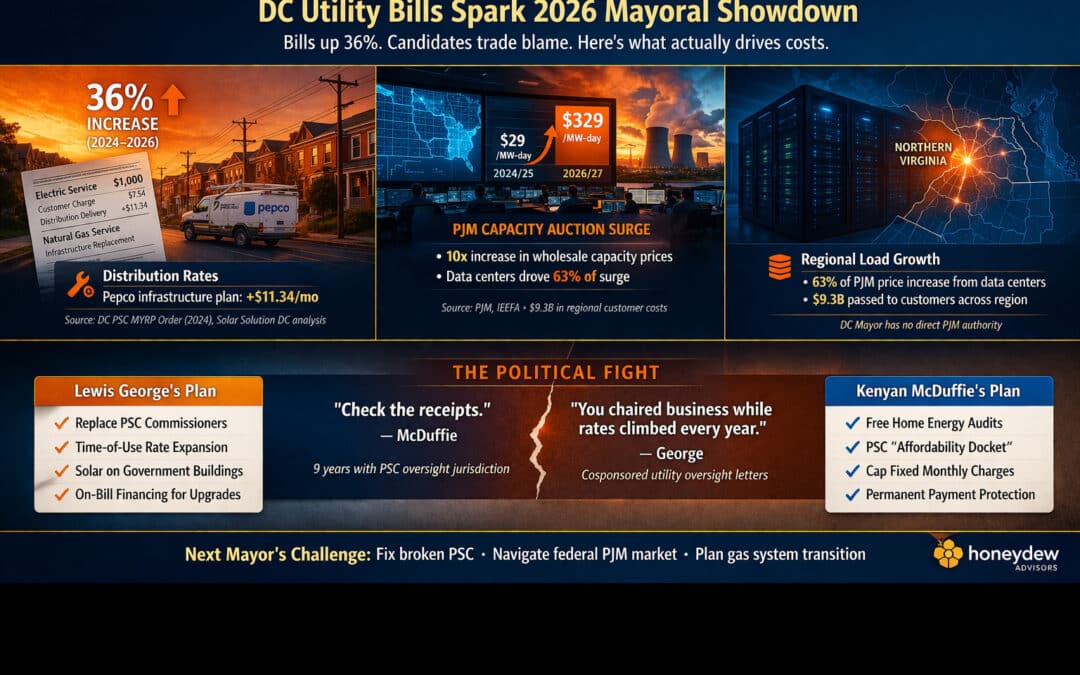
Average gas and electric bills in DC have each increased roughly 36 percent between 2024 and 2026, according to data from the DC Office of the People’s Counsel. For residents, that is not an abstraction. A Glover Park retiree recently told the Washington Post her electric bill topped $1,000 in January. Neighborhood listservs have been flooded with complaints for months.
What is actually driving those increases? The answer has at least three distinct components, and the candidates have so far addressed only one of them with any seriousness.
The first component is Pepco’s distribution rate: the cost of maintaining the wires, transformers, and infrastructure that carry electricity to your building. The DC Public Service Commission approved Pepco’s Multi-Year Rate Plan in late 2024, authorizing $123.4 million in additional distribution revenue over 2025 and 2026, adding roughly $7.54 per month to the average residential bill in 2025 and another $3.80 in 2026 according to our friends at Solar Solution DC.That approval went through despite a dissenting PSC commissioner who described the process as a “regulatory trainwreck.” The DC Court of Appeals later threw out the underlying order, finding the commission failed to hold a proper hearing.
The second component is the supply charges, which is where things get genuinely complicated. Pepco’s DC Standard Offer Service customers do not buy electricity directly from generators. Their supply cost flows through PJM, the regional transmission organization that runs the wholesale electricity market serving DC and 13 other states. PJM runs annual capacity auctions that set the price utilities must pay to reserve generating capacity for peak demand periods. Capacity prices jumped from roughly $29 per megawatt-day in the 2024/2025 delivery year to $270 per megawatt-day in 2025/2026 (nearly a tenfold increase) and climbed further to $329 per megawatt-day for 2026/2027. IEEFA Those costs flow straight through to customer bills, dollar for dollar, with no PSC markup and no local political authority over the outcome.
The third component is load growth driven by data centers. PJM’s independent market monitor has estimated that data centers were responsible for 63 percent of the price increase in the 2025/2026 capacity auction, translating to $9.3 billion in additional costs recovered from customers across the PJM region in higher electric rates. Most of those data centers are in Northern Virginia’s Dominion zone, but because PJM operates as an integrated market, demand growth anywhere in the region raises capacity prices everywhere in it, including DC.
On the natural gas side, Washington Gas has pursued parallel rate increases to fund the replacement of aging cast iron and steel distribution pipes throughout the city, a legitimate infrastructure need that has nonetheless generated justified scrutiny about whether customers should fund replacements on infrastructure that may have a short useful life given the District’s electrification goals.
The Political Fight
The loudest exchange happened at a March 14th “Free DC” forum in Anacostia, where frontrunner Kenyan McDuffie repeatedly told the audience to “check the receipts” and accused Lewis George of failing to introduce standalone legislation on utility costs. Lewis George shot back that McDuffie, as chair of the council’s business committee, had oversight of the PSC for nine years while rates climbed every year. This exchange resulted in a screaming match, prompting McDuffie to walk off the stage mid-debate.
Both attacks have some merit and both are incomplete.
McDuffie did chair the committee with PSC oversight jurisdiction for nearly a decade. He did not sign two council letters in 2024 and 2025 questioning whether Washington Gas could justify forcing customers to fund pipe replacements given the city’s electrification trajectory. His campaign says he preferred engaging the commission through formal hearings rather than letters, which is a defensible procedural choice but does not explain the absence of more aggressive action on distribution rate cases where the council’s oversight tools were directly applicable.
Lewis George cosigned those letters and supported the Allen led oversight push. She was, however, the lone vote against a 2022 solar expansion bill, citing concerns that the program structure would increase costs for low-income ratepayers. The Sierra Club shared those specific concerns at the time, which makes the vote more defensible than McDuffie’s campaign has suggested, but it still handed opponents a clean line of attack.
What Are the Candidates Actually Proposing?
Lewis George has released a 10 point utility plan. Its strongest elements involve PSC appointments (two commissioners are up for reconfirmation before the end of April) and an expanded time-of-use rate structure that would give customers more control over their bills based on when they consume electricity. She also proposes expanding solar on DC government buildings and vacant lots and extending solar incentive programs to renters. She wants Pepco to allow customers to finance energy upgrades through their monthly bills, a model sometimes called on-bill financing that has worked in other jurisdictions.
McDuffie describes his approach as “all of the above.” His more substantive proposals include free home energy audits, a consolidated resource hub for customers seeking bill relief, expanding community solar, and making pandemic-era payment protection policies permanent. He has called for caps on fixed monthly charges and longer-term zero-down payment plans for customers carrying arrears.
McDuffie has also called for an “Affordability Docket” requiring the PSC to evaluate every major rate case by its impact on household budgets across every ward. That is a genuinely useful structural reform if implemented rigorously, because the current rate case process tends to optimize for aggregate revenue requirements rather than distributional impacts.
Where Both Candidates Fall Short
Neither candidate has addressed the PJM capacity market problem with any specificity, and that is a significant gap. The single largest driver of supply cost increases in the DC Pepco zone over the past two years has not been PSC decisions. It has been a near-tenfold increase in PJM capacity auction prices driven by data center load growth in Northern Virginia. The DC mayor has no direct authority over PJM. That market is governed by FERC at the federal level. But a DC mayor with serious command of the issue could push hard on regional coordination, advocate loudly for data center demand accountability in PJM’s planning processes, and use the city’s standing as a major electricity customer to intervene in federal proceedings.
Lewis George’s proposal to work with regional leaders on data center accountability is the closest either candidate has come to naming this dynamic directly. It is a start, but the proposal lacks any specific mechanism. PJM’s capacity market structure, its locational deliverability area for the Pepco zone, and FERC’s ongoing rulemaking on co-location and large load interconnection are where the real leverage points are. Neither candidate has demonstrated fluency there yet.
On the distribution side, the strongest move any incoming mayor could make is remaking the PSC. The current commission approved a $123 million rate plan that a DC court later threw out for procedural failures serious enough that the dissenting commissioner called it a regulatory trainwreck. The Office of the People’s Counsel is now pressing the commission to roll back electric rates to pre-increase levels and refund customers the difference. Whoever wins this race will take office with at least two commissioner seats to fill and an institution whose credibility with ratepayers is at a low point.
On natural gas, the council letters from Allen and Lewis George raised exactly the right question: why should DC customers pay to replace gas infrastructure with a 40-year useful life when the city has committed to being carbon-neutral well before that timeline? A serious mayoral energy platform would include a formal decarbonization stress test for any Washington Gas capital investment seeking rate recovery. Neither candidate has proposed one.
The Bottom Line
Utility affordability is a real and urgent issue for DC residents and building owners alike, and the candidates deserve credit for making it central to the race. But the policy conversation has so far been shaped more by blame assignment than by the structural complexity of the problem. The PSC matters, but it controls only distribution rates and the framework for supplier procurement. The supply side, which for most large commercial customers in the Pepco zone represents more than half of total electric cost, flows through PJM wholesale markets that operate largely outside any local official’s reach.
The next mayor will inherit a broken PSC, a federal capacity market that has tripled in price in three years, a natural gas system whose long-term future is genuinely uncertain, and a commercial real estate sector increasingly exposed to energy cost volatility. The candidate who earns the job should be able to explain all of that clearly – not just who to blame for the last three years of bills.